
Standart Inspection

Residence Inspection

A Defined Method for Private Residences
An inspection of your residence — its overall condition, or a specific problem — with the relevant specialists where needed. You receive documented findings with photographs, each ranked by priority, and a clear list of what should happen next.
Request an InspectionView Sample Report Excerpts →
For your first message, the residence’s area, your main concern and preferred timing are enough. You do not need to share an exact address or private documents at this stage. Scope and fees are agreed in writing before work begins.
- Who it is for
- Owners who want a clear, evidenced view of their residence’s condition — and the family offices, representatives and house managers who act for them. Villas and branded residences in Bodrum, the Aegean and Istanbul.
- What you receive
- An on-site inspection within the agreed scope, photographed findings, a risk and priority classification, a clear report and recommended next steps.
- What it helps you decide
- What needs intervention, what comes first, where a specialist should be brought in, and which findings should shape a renovation scope or a handover.
- Our role
- We assess the matter, bring in the relevant specialist where it is needed, and give you evidence-based visibility. Taken on its own, Standart Inspection is a separate engagement that gives an independent assessment within the agreed scope, with our relationship to the work stated; where Standart also manages the residence, inspection is part of that management and is reported as internal control. The role is set out in the contract. An inspection is not an engineering certification, and not every root cause can be confirmed in a single visit; where it cannot, the report says so.
When
Once, or to the rhythm of the year
The same method, timed to what the residence needs — a villa inspection you can take once, around a sale or a season, or as a programme.
- One-off condition assessment
- The present state of the residence, recorded once — on taking over a house, or simply to know where it stands.
- Before or after a sale
- A pre-purchase inspection before you commit, or a condition record when you take over or prepare to sell.
- Pre-season readiness
- Before the house opens, while there is still time to act on what is found.
- Post-season closing
- When the season ends and before a long absence: what is left behind is recorded, and what the winter will test is secured.
- Seasonal or annual programme
- Inspections set to the year — for example monthly for a residence that stands empty, quarterly, or once each season — agreed in the proposal.
- Before renovation
- A root-cause investigation before the scope of works is decided. Where the problem requires it, a survey by several engineers and specialists together.
- At handover
- A handover inspection when the works, or a newly built residence, are handed over.
- On request
- The whole fit-out of the house, or one specific problem — a leak, damp that spreads, a pool that loses water — examined and reported with the relevant specialist.
What you receive
What you receive
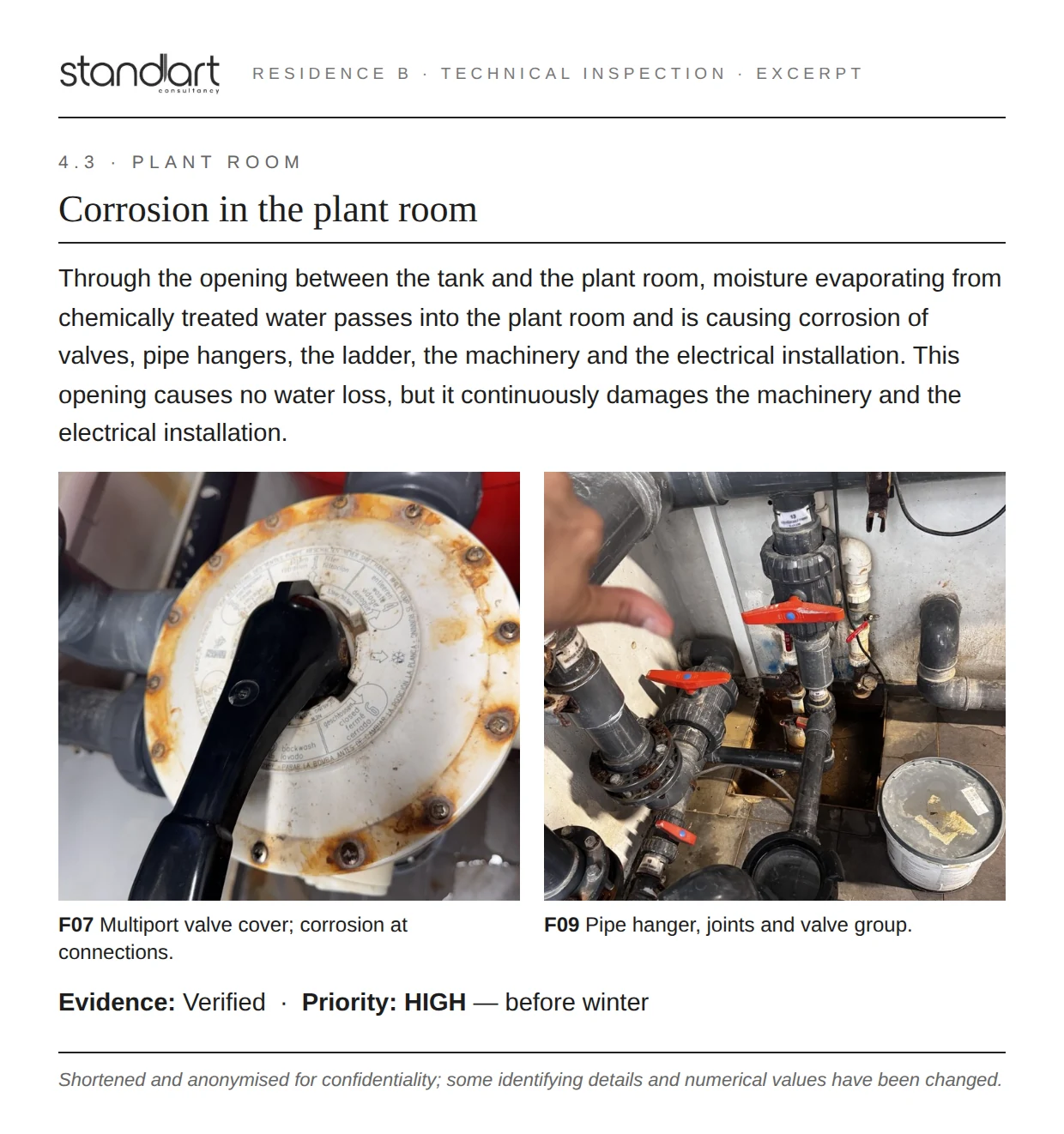
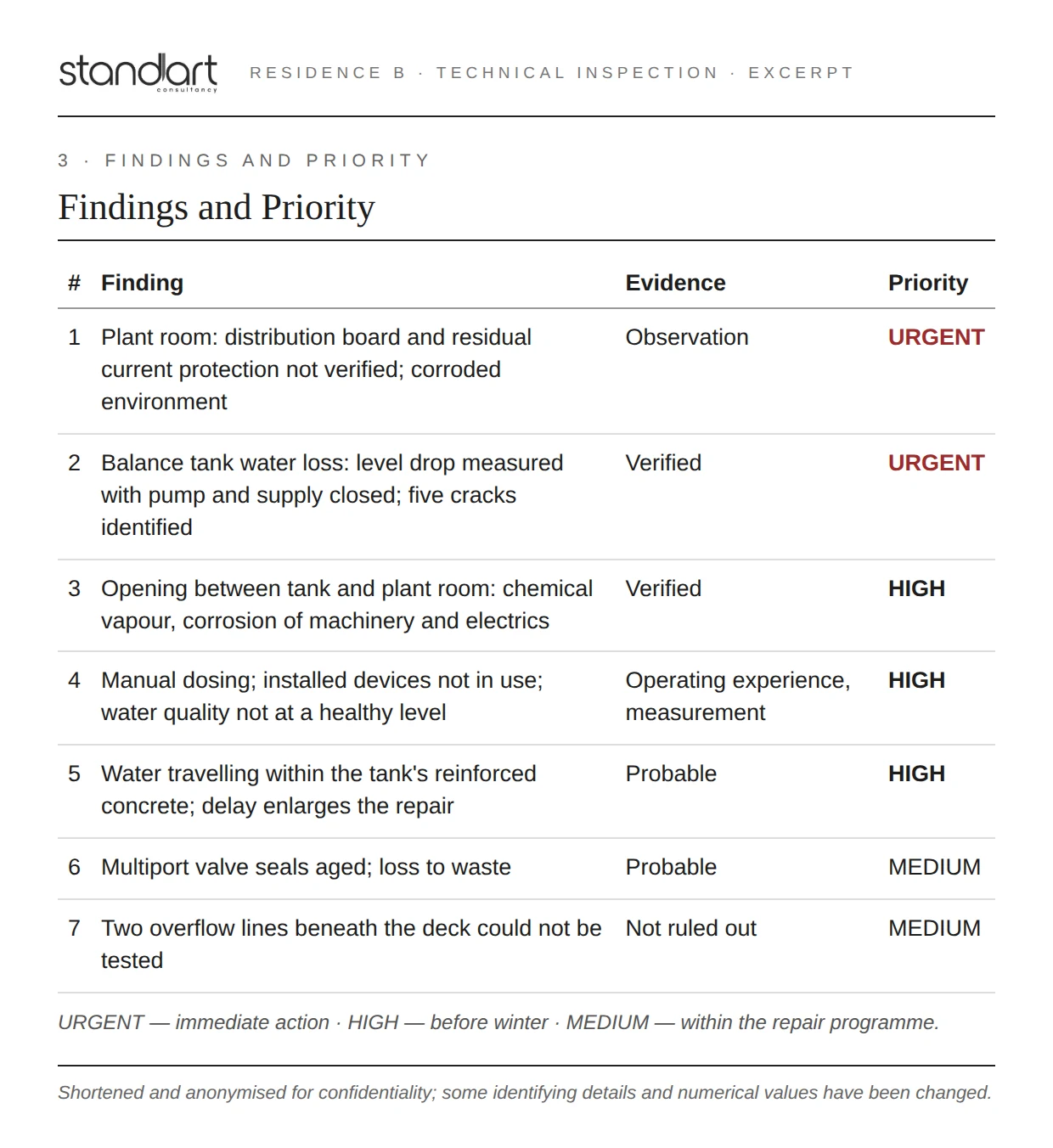
Four excerpts from recent reports show how findings are presented, and how they help the person who has to decide.
Anonymised sample report excerpts


Shortened and anonymised for confidentiality; some identifying details and numerical values have been changed.
Discuss an inspection for my residence
In the field


Field photographs show how the work is done. They are not evidence for the report excerpts above.
Related reading: Water Is the Quiet Risk · Salt, Sun and Stone · The House That Winters Well · Water, Done Properly
A case in brief
From a symptom to a decision
- The starting point
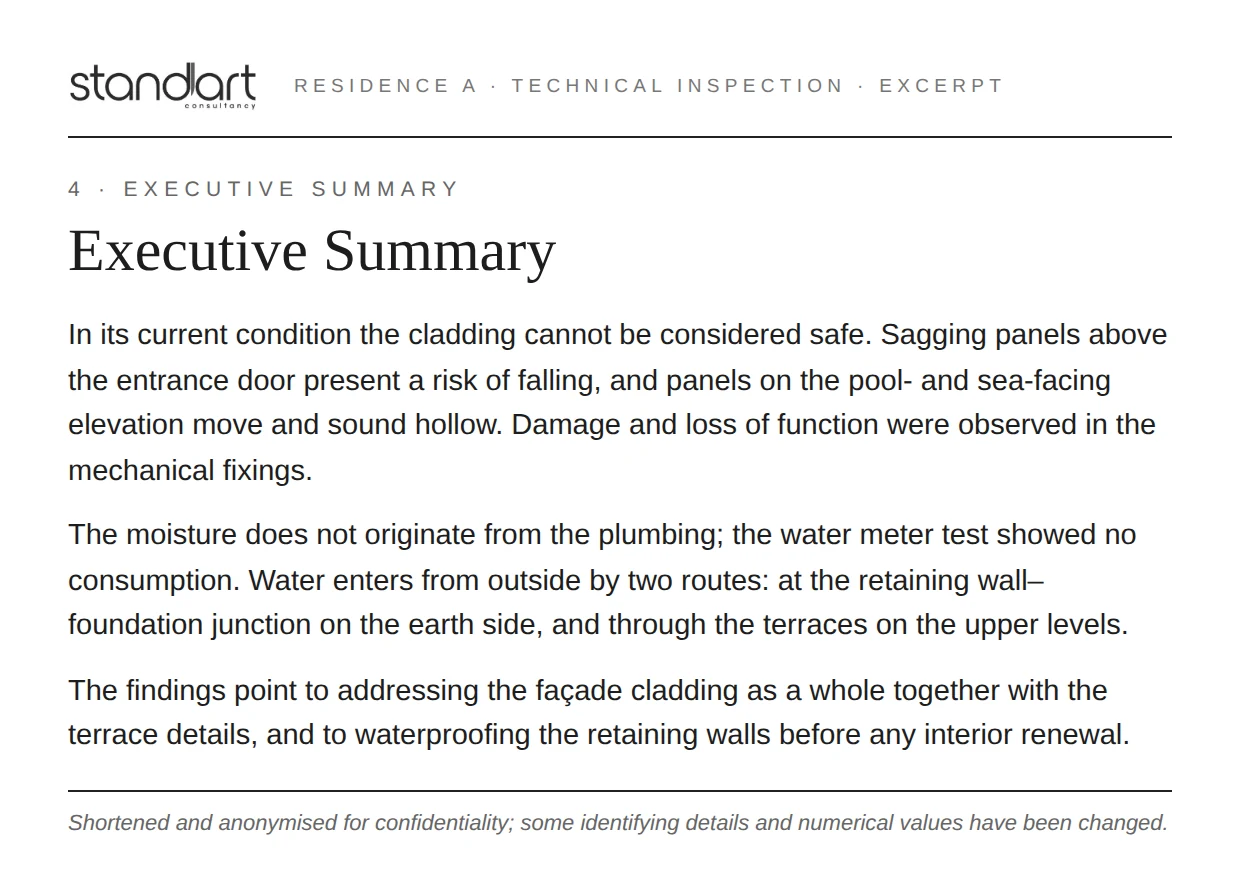
- The owner of a private residence on the Aegean coast reported cracked and fallen façade panels, and a damp, musty smell in every season. The house had stood largely unoccupied.
- What was inspected
- Façade panels were tap-tested and measured; the water meter was read at the start and end of the visit; sheet tests were placed at numbered floor points, and moisture was measured on a second visit. Every observation was recorded with time-stamped photographs.
- What was documented
- Loss of fixing in the cladding, with a risk of falling panels. The water meter showed no movement during the visit. That did not rule out every plumbing possibility, but moisture readings and on-site observation directed the investigation to water entering from outside — at the retaining wall–foundation junction and through the terraces. Points needing further investigation were set apart.
- The decision it made possible
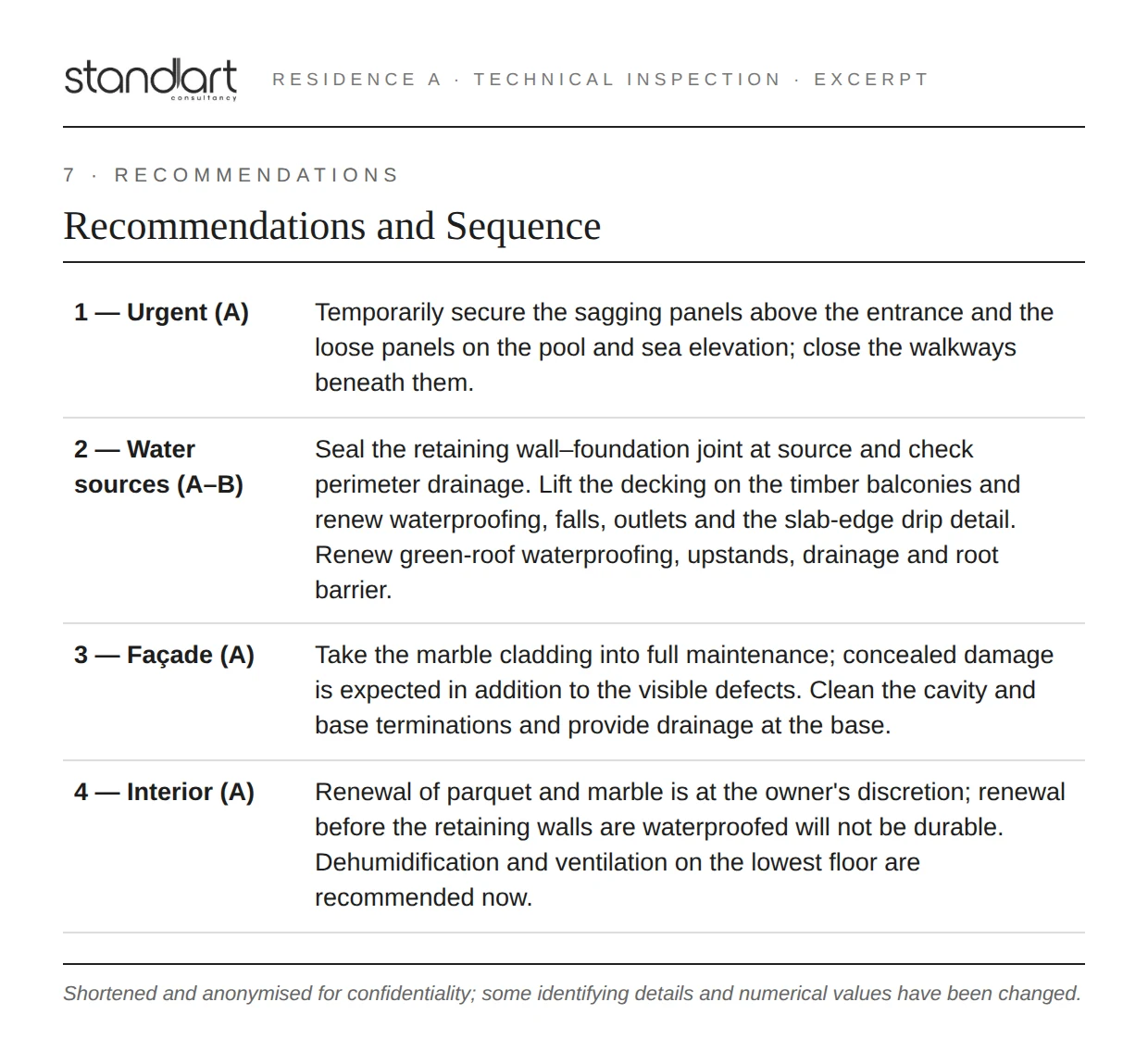
- Secure the loose panels first; deal with the water sources before any façade or interior renewal; treat the cladding together with the terrace details rather than panel by panel. Interior renewal remains the owner’s decision — the report sets out why doing it before waterproofing would not last.
The report records findings and recommendations. It makes no claim that repairs have been carried out.

How it starts
Five steps
- Request — tell us about the residence and what concerns you.
- Need and scope — we clarify what you need to know and agree what will be inspected.
- Proposal — scope, timing and fee confirmed in writing.
- Site inspection — on site, within the agreed scope.
- Report — findings, priorities and next steps, delivered to you.
Scope, timing and fee are set in a private proposal.
Inspection and Standart Residence OS. Standart Inspection can be taken on its own. When the residence moves to ongoing service, its findings become tasks, follow-up and verified closure inside Standart Residence OS — who is responsible, what is still open, and what has been closed.
The method
Most inspection of private residences is a walk-through. Somebody experienced looks at the house, forms a view, and describes it afterwards. Standart Inspection is not that. It is a defined method with a fixed sequence, a written baseline, and two distinct forms of check. It produces a record rather than an opinion.
Scope. The full residence baseline inventory belongs to a comprehensive inspection; for an inspection aimed at a specific problem, deliverables are limited to the agreed scope.
Standart Inspection can be taken once, or set to a calendar. Either way, it establishes the residence’s technical baseline and keeps it current. The baseline it produces becomes the residence’s technical memory inside Standart Residence OS.
- Timing
- One-off, pre-season, post-season, monthly, quarterly, before renovation and at handover
- On site
- Set by the scope, with the founder present for the baseline
- In hand
- A signed report, on the date agreed in the proposal
- Every photograph
- Stamped with the time and the position it was taken from

The Procedure
From symptom to root cause
A tap runs dry. That is a symptom, and most maintenance stops there: someone is called, the booster is reset, the water returns. The event is closed. Nothing has been learned, and the same call will come again.
Standart Inspection treats the symptom as the last link of a chain and follows it back. The tap is fed by local pipework, the pipework by a manifold, the manifold by a pressure vessel, the vessel by a booster, the booster by a filter, the filter by storage, and storage by the supply. Each link is a candidate, and each is checked in order until the failure is located rather than guessed at.
Locating the failure is not the end of it. A booster that has failed once will fail again, and the question is why. A pressure vessel that has lost its charge; a filter that was never on a schedule; a pump running against a partly closed valve for two years — these are root causes, and each one has a date, a service history and a responsible party in the system register.
That is where inspection turns into prevention. Once the root cause is recorded rather than the symptom, the item moves onto a schedule built on running hours and installation dates rather than guesswork. The next failure is caught earlier, or prevented — the risk is reduced rather than waited for.
This is the difference between a residence that is fixed quickly and a residence where failure is anticipated. The first depends on how good the telephone number is. The second depends on what is written down.
PRINCIPLE ONE
Every house has two inventories
There is the inventory the owner knows: rooms, terraces, the pool, the kitchen, the gate, the cars.
And there is the inventory that actually keeps the house working: the booster pump, the pressure vessel, the expansion tank, the residual current device, the surge protector, the non-return valve, the condensate drain, the sacrificial anode, the earth rod, the sump pump, the transfer switch, the roof outlet nobody has looked into since the house was built.
The first inventory is used deliberately. The second is used without being known — every time a tap is opened, a light is switched on, or a door closes behind someone.
That second inventory has one defining property: the owner learns of each item at the moment it fails. And at that moment it is no longer a maintenance event. It is an incident, at the worst possible time, at several times the cost.
Standart Inspection exists to move that inventory from invisible to recorded, before it introduces itself.
PRINCIPLE TWO
The baseline comes first
Nothing meaningful can be inspected repeatedly until it has been established once. The initial setup is a single, thorough pass that produces three documents.
The volume register. Every volume in the residence — not only rooms. Plant rooms, tank rooms, pump houses, roof voids, under-stair spaces, technical shafts, service corridors, garden stores, cellars, the space behind the pool wall. The volumes an owner never enters are where the risk concentrates, precisely because nobody enters them.
The system register. Every system, identified, located, photographed, rated, dated and labelled. Make, model, capacity, installation date, service history where it exists, warranty status, and the party who installed it.
The map between them. Which system serves which volume. Which board feeds which circuit. Which valve isolates which run. Which volume goes dark, cold or dry when a given item fails.
This third document is the one almost no residence has, and it is the one that matters most. It converts “the water has stopped” into “the booster serving the west wing has stopped, it is in the lower plant room, here is the isolation point, and here is who installed it.”
After the baseline exists, every subsequent inspection is a comparison rather than a discovery.
PRINCIPLE THREE
Inside out
Most inspections work outward-in: walk the plant room, tick the equipment, move on. This records what exists. It does not record what depends on it.
Standart Inspection runs the other way. It begins in the volume the owner occupies and follows each visible thing back along the chain that serves it.
From a tap: outlet, fitting, local pipework, manifold, pressure vessel, booster, filter, storage, supply.
From a socket: outlet, circuit, protective device, distribution board, main switch, earthing.
Everything visible is the last link of an invisible chain, and the chain is the thing being inspected.
THE METHOD
Two checks, not one
Every system receives both.
Visual. Condition, corrosion, ingress, leak evidence, wear, labelling, access, clearance, mounting, signs of previous repair.
Functional. It is operated. The residual current device is tested, not confirmed present. The pump is run under load, not observed at rest. The transfer switch is triggered. The valve is closed and reopened. The alarm is sounded. The door is cycled.
The distinction is the entire point: most equipment looks correct right up until it is asked to work. A visual inspection tells you what something looks like. A functional test tells you what it does.
Where a functional test cannot be performed without risk or disruption, that is recorded as an untested item rather than silently passed.

THE OUTPUT
What is produced
Each item carries a location, a photograph, a condition, a function status, a severity, a responsible party and a due date.
Urgent safety items are separated from comfort and improvement items, so decisions are made in the right order rather than the order in which things were found.
Nothing is closed on assurance. It is closed on verification. The output goes to the owner or the family office.
| Every recorded item carries | |
|---|---|
| Location | Which volume, from the volume register |
| Photograph | The item as found, stamped with its time and position |
| Condition | What it looks like — the visual check |
| Function status | What it does — the functional test, or untested |
| Severity | Urgent safety, separated from comfort and improvement |
| Responsible party | Who carries it |
| Due date | Closed on verification, not assurance |
AFTERWARDS
How the baseline is used
The baseline becomes the residence’s technical memory inside Standart Residence OS.
Recurring inspections compare against it. Preventive maintenance schedules are built from it, on running hours and installation dates rather than guesswork. Vendor scopes are written from it, so a contractor is quoting against a known installation. And when a caretaker or manager leaves, the knowledge does not leave with them — because it was never in their head. It was in the register.
The Systems You Use Without Knowing · Villa Inspection & Audit
The Reports
One register, every inspection
The baseline is established once. Everything after it is a comparison against that record — the same registers, revisited. Which inspections run, and when, is the owner’s choice: once, to the season, monthly, quarterly, or around a renovation or handover. See when to inspect.

The Record
Signed, stamped, delivered on an agreed date
Time on site and the delivery date are set in the proposal, according to the scope.
Every report is delivered signed, on the date agreed.
Every item carries a photograph, stamped with the time it was taken and the position it was taken from. A record made this way holds up later — for the owner, for the family office, and for anyone afterwards who has to rely on what was found, and when.
The Team
Who carries out the work
The work is carried out by the Standart Consultancy team. The founder is present for the initial inspection of every residence — the pass that establishes the baseline everything else is measured against.
Engagement
How it is taken up
Standart Inspection begins with the baseline. It is scoped on the residence itself — the volumes and systems to be recorded — rather than on time spent.
Once the baseline exists, reports run as an annual programme, or singly as events require.
Terms on application.
Delivered
What the owner receives
For a comprehensive inspection, the baseline below. For an inspection aimed at a specific problem, deliverables are limited to the agreed scope.
- The volume register — every volume in the residence, not only rooms
- The system register — each system identified, located, photographed, rated, dated and labelled
- The map between them — which system serves which volume, and what fails with it
- An item record carrying location, photograph, condition, function status, severity, responsible party and due date
- Urgent safety items separated from comfort and improvement items
- Untested items recorded as untested, rather than silently passed
- A signed report on the date agreed, each photograph stamped with its time and position
- The baseline held as technical memory inside Standart Residence OS
Request an Inspection
Tell us about the residence and what concerns you. Scope, timing and fee are set in a private proposal.