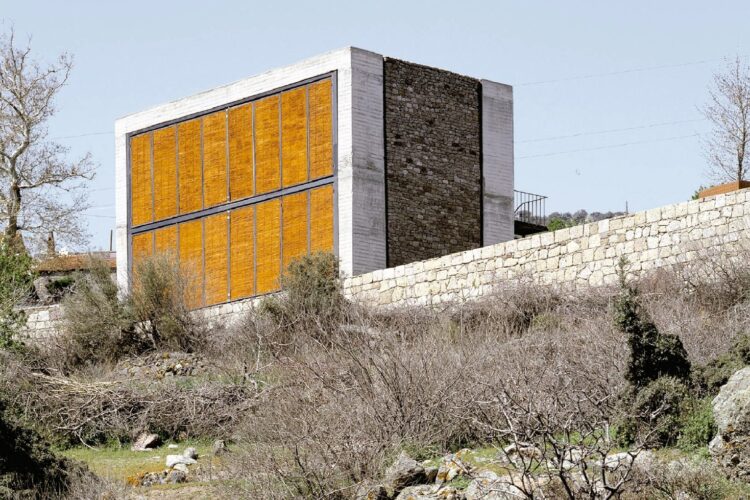
There are houses on this coast that are visibly better at twenty years old than they were at five.
The stone has darkened and settled. The timber has silvered rather than split. The planting has closed around the building the way it was drawn to. Nothing about them reads as new, and nothing reads as tired. They look, simply, like they belong there — which is the only compliment that matters in this landscape.
What those houses have in common is not budget. Some of the most beautifully aged buildings on the Aegean were built modestly. What they have in common is that somebody understood, early, that a house here is in a continuous conversation with salt, sun and water, and that the conversation goes well only if you are paying attention to it.
Patina and decay are not the same thing
The distinction matters, because a great deal of well-intentioned maintenance destroys the first while trying to prevent the second.
Patina is what happens when a good material weathers as it was designed to. Lime plaster chalks gently. Untreated timber greys. Stone deepens. Bronze and unlacquered brass go through a colour range that no finish can imitate. Terracotta collects lichen. These are not faults. They are the material doing what it was chosen for, and they are most of the reason old Aegean buildings feel the way they do.
Decay is different, and it is almost always the result of water going somewhere it was not meant to go, and then being unable to leave.
The most consequential single decision in the maintenance of a traditional building here is refusing the products that trap moisture: cement render over lime, waterproof paint on breathable walls, chemical sealant in joints designed to move. They look like protection. They are the mechanism by which a wall that stood for a century begins to fail in the third year after somebody helped it.
The calendar the coast writes
Houses that age well are on a schedule, and the schedule is not the manufacturer’s. It is the one this climate dictates.
Autumn, before the rain. Roof, gutters, drains, terraces, retaining structures, slope drainage. This is the single most valuable month in the year and the one most often skipped, because in October nothing appears to be wrong.
Winter, in the empty months. Damp at the wall base. Timber. Anything closed and unheated. A house checked three times over winter is a house in which small problems are found while they are still small.
Spring, before the season. Systems opened, tested and run under load. External joinery, shutters, sealant, awnings. The heavy work, done when contractors are available and prices are sane.
Summer, lightly. Verification rather than intervention. The house is in use; the work should already be done.
The rhythm is not complicated. It simply has to exist, and somebody has to own it.
Materials that reward attention
Stone and lime, maintained correctly, effectively do not have a service life; they have a maintenance regime. Repointing is cheap and periodic. The wall lasts longer than any of us.
Timber outdoors, left untreated and detailed so water drains off it, silvers and lasts. Timber sealed with the wrong product traps moisture and rots from inside.
Terracotta and natural clay improve. Lime wash can be renewed for very little, which is why it was used for two thousand years.
Bronze, copper and unlacquered brass move through colour and stabilise. Chromed and lacquered metal near salt water does not; it looks perfect and then it looks finished.
None of this is nostalgia. These materials were selected over centuries in this exact climate by people with no margin for error, and they still outperform most of what replaced them.
The economics of doing it properly
Preventive maintenance is often argued for defensively, as insurance. That undersells it.
A house maintained on a calendar costs less to run, because scheduled work is cheaper than urgent work by a wide margin. It also spends far less of the owner’s attention, which is the more valuable currency. And it holds value in a way that is legible to the next buyer, who can see in five minutes whether a house has been looked after or merely occupied.
But the honest reason to do it is simpler. A house that is well kept is a nicer place to be. The doors close properly. The water runs hot. Nothing rattles in the meltemi. The light in the evening falls on surfaces that have been allowed to become themselves.
That is not an investment argument. It is the whole point of having the house.
Villa management, governed · Salt, Sun and Stone · The Discipline of Preventive Maintenance
Prefer to speak first? Book a discovery call →