
Standart Residence OS


Standart Residence Operating System
Residence Governance · Operating System
Standart Residence OS is the residence operating system in which we track findings, work, responsibilities, expenditure and approvals together. It supports Standart’s direct management, or the advice and follow-up we give an existing team. Hikmet’s assessment works inside it — what matters, in what order, and when a piece of work can be considered closed.
Discuss Your Residence’s ManagementBook a discovery call →
Standart Residence OS is not sold as standalone software, and it is not only a reporting panel. It is how Standart runs residence management and governance — Hikmet’s judgement deciding what matters, human follow-up making sure it is done, and the system keeping both continuous when people change.
User Entry
Access Standart OS →
Secure, role-based access for owners, family offices and residence operations.
Day to day
What changes in the running of the house
- Work and decisions lost in WhatsApp conversations
- Each task and decision is recorded with who raised it, who owns it and what was decided — searchable later, not buried in a chat.
- Reports, photographs and invoices scattered across folders
- Each document is attached to the finding, task or expense it belongs to.
- Work nobody can say was assigned or finished
- Every task has a responsible person and a status, and it is closed only after it has been checked.
- Spending reasons and open issues that never reach the family office
- Expenditure carries its reason and its approval; open issues stay visible until they are closed.
- Residence knowledge that leaves with the staff
- Vendors, assets, documents and the history of decisions stay with the residence, not with a person.
Who keeps the record
The owner does not have to use the application. Day-to-day records are kept by the residence team and the manager — Standart, or your own team with our support. The owner and family office receive a summary in the form agreed in the contract, and can see the system by role if they wish.
One piece of work, end to end
- Notification. A fault or need is reported — by staff, during an inspection, or by the owner’s side.
- Assignment. It is given to a named person, with a priority.
- Work. The work is carried out and photographs or documents are added to the record.
- Check request. The person responsible asks for the work to be checked.
- Manager verification. The manager checks it against the original finding before it is closed.
- Owner summary. The closed work, and anything still open, appears in the owner’s summary.
An illustrative sequence, written out rather than shown, so that no client record appears on this page.
A residence of this level is not a single task. It is inspections that must happen on time, maintenance that is planned so the risk of failure is reduced, vendors held to a defined scope, expenditure that needs an owner’s or family office’s visibility, and a memory of the house that survives a change of staff. When these live only in one person’s head, the residence is exposed. Standart Residence OS turns them into a structure that continues to work regardless of who is on duty.
What the owner sees
The residence, in one record
An inspection tells you where the residence stands. Ongoing management in Standart Residence OS keeps those findings in view and carries them through to closure — so nothing depends on memory or a chain of messages.
- The daily status of the residence, and its inspection records
- Findings with photographic evidence attached
- Open work: its priority, and who is responsible for it
- Each finding advanced step by step to closure, with closed items kept on record
- Maintenance, documents, assets, suppliers and cost approvals kept in the residence’s memory
- Visibility set by role — owner, family office, residence team, inspector
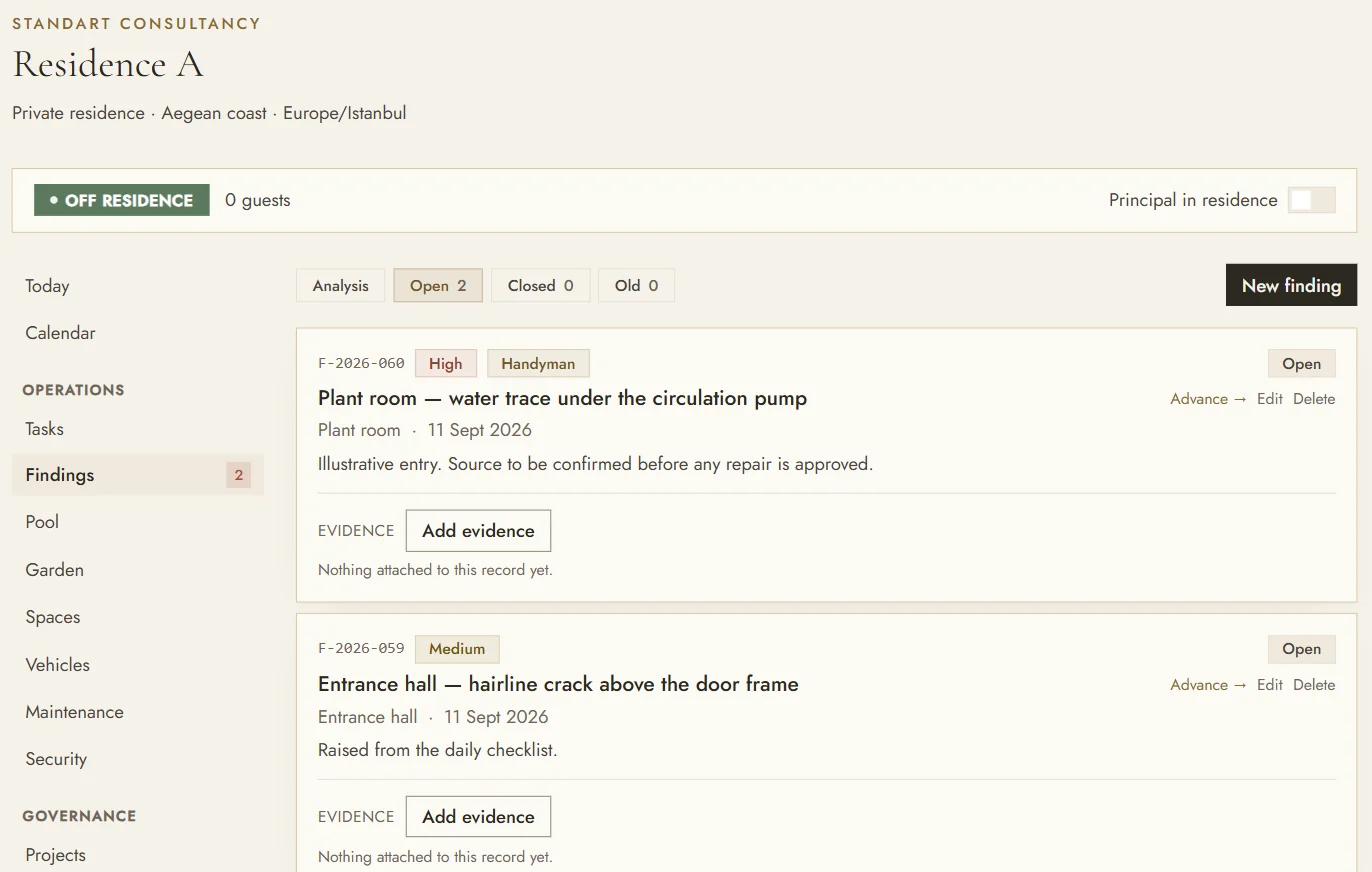
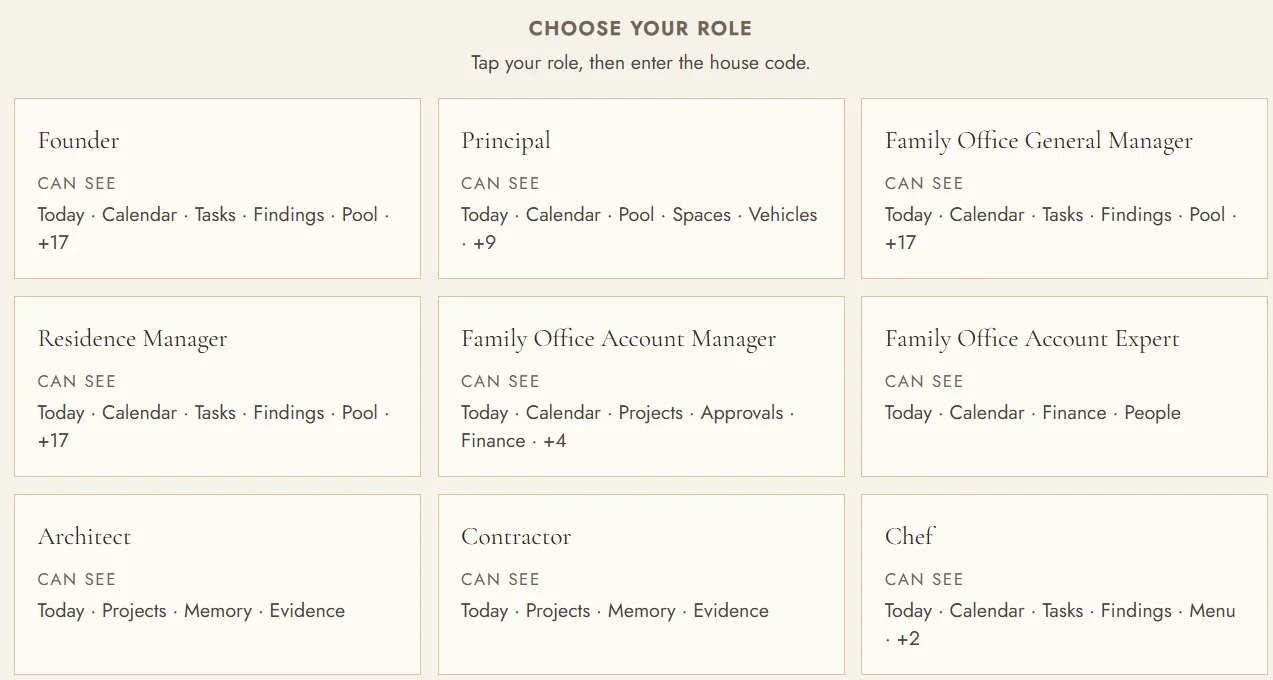
When a clear view of condition is needed first, Standart Inspection provides it; its findings then become tracked work here. View Sample Report Excerpts →
01 — The framework
Five pillars
A Residence Operating Manual defines how the home is run. Vendor governance holds suppliers to scope, cost and responsibility, in writing. An institutional residence memory keeps every document, asset, inspection and decision in one place. Private-property risk control surfaces a problem before it becomes a cost or a danger. And continuity and family-office oversight give the people accountable for the home visibility — without requiring their involvement in the day-to-day.
02 — In practice
What it looks like
A disciplined rhythm of daily, weekly and monthly checks; findings that carry a clear severity and a named owner until they are resolved; preventive maintenance scheduled rather than improvised; pool, water and technical readings recorded and verified; and reporting written in the owner’s language — brief, factual, and separating an urgent safety matter from a comfort improvement.

03 — Balance
Three interests, held in balance
The framework holds three interests in balance at all times: the owner’s lived experience, the family office’s need for oversight, and the protection and continuity of the residence itself. A residence that pleases the owner but leaves the family office without visibility is incomplete; so is one that satisfies the family office but erodes the owner’s comfort. Standart exists to coordinate all three.
We institutionalise the operation — not the home. The house remains private, quiet and personal. What becomes disciplined, documented and continuous is the way it is run.

What the owner receives
What turns judgement into something auditable and continuous — depending on the residence:
- A Residence Operating Manual
- Inspection rhythm and reporting structure
- Vendor register and responsibility matrix
- Asset, key and document inventory
- Preventive maintenance calendar
- Pool, water and technical-system records
- Issue log with severity, owner and resolution status
- Arrival-readiness and handover protocols
- Family office reporting format
The purpose is simple: the residence should not depend on memory, goodwill or informal messages. It should have an operating record.
Discuss your residence
A first conversation usually begins with one question: should Standart run the residence, or support the team already there?